Monday, February 11, 2008

The Costa Rica "Make-a the Sex" tour 2008

Greetings, avid readers! Pull up a chair and get comfy, ‘cause it’s gonna be a long one. Well, if you hadn’t already heard (which would be hard since I’ve been bragging since my holidays were approved), I recently made a 2 week foray into the world of Central America, in the form of a trip to Costa Rica. I went with 2 friends, Becky and April, who I’ve known since the days of university. We backpacked around to various parts of the country for almost 2 weeks, spending a couple days in each place.

I’d go through the whole trip and give you an itemized list of what we did and where we went, but that would be boring and not at all my style. So I’ll try and give you the highlights, city by city.

Jaco/Playa Hermosa. It was so hot in Jaco we literally couldn’t wear clothes. We just walked around in our bathing suits. Which was OK since everyone else was doing the same thing. We went surfing while we were there, which was fantastic because the waves were strong enough I actually managed to get standing on my board. We stayed at a hotel right on Playa Hermosa (Hermosa Beach), so we could watch the waves come crashing in whenever we wanted, and our hotel had A/C, which was fantastic since it made it so much easier to sleep.


Isla Tortuga. We went on a day cruise from San Jose to Tortuga island. The ship we took had a bar, so naturally we had to have a pina colada or two. The best part of that was that they opened the cans of coconut milk with a machete. The tour took us to Puntareanas and they we sailed to Tortuga Island, where we spent 4 hours and had a fantastic lunch. At one point we were considering “forgetting” to get back on the boat and getting stuck on the island. The beach was too perfect, and the water was unbelievably warm. But we did get back on the boat.

Monteverde. We did quite a bit with our 3 days in Monteverde. We went on a guided night hike in the rainforest. We also went on a short hike through a cloud forest, which looks exactly like you think the rainforest should look like-huge trees, plants growing on plants growing on plants, and green everywhere. We also took a zip line tour. The first one was a little scary, but each line after that was more and more fun. The longest line was 750 m. The day we went it was raining and really windy, so on the last 2 lines they sent us across 2 at a time, so we’d have enough weight to make it to the other side, because the wind slows you down. What we did was the person in front would scrunch themselves up in the fetal position, and the person behind would wrap their legs around the person in front. Since there was an odd number of us, we got paired with an Australian fellow named Wade. So feel free to make as many jokes as possible about April having a strange man’s legs wrapped around her. We also went on a horseback ride on some tiny Costa Rican horses. We managed to miss the rainy season, but no one mentioned there’s a windy season in Monteverde. The wind just howled the entire time we were there. And it gets rather difficult to sleep when the wind is screaming so loud outside your window you swear it’s gonna blow the whole building right off the hill. Maybe that’s why the buildings are all made of concrete…


La Fortuna. We had the best time of the whole trip in Fortuna. We took a tour near the volcano, watched the glowing lava rocks from the volcano, and sampled the local liquor known as guaro (a little bonus our tour guide brought for us-never let a Costa Rican guy pour you a drink. It’s like 50/50 kids). We went to the hot springs where Becky got so sloshed off a drink called a 10 o’clock last call (one guess why it’s called that) we thought we might have to carry her back to the hostel. We went on another horseback ride, and deviated from the itinerary slightly by going bungee jumping-April paid and we called it my birthday present. Apologies to my mom’s friend Darlene at this point, since I had promised my mom I would never bungee jump and then sent her an email right after I did it, and Darlene had to walk with my mom that day at lunch after she had gotten the email. But the bungee was the biggest adrenaline rush I’ve ever had, which for me is really saying a lot. Our last day in Fortuna we went waterfall rappelling, which was fantastic, even though some of the rappels were right into waterfalls and we got a little damp.


San Jose. We were in San Jose off and on for several days on the trip. It’s a huge city, very confusing, but interesting nonetheless. We managed to get to Mercado Central, a big market selling everything you could possibly imagine (and lots of low-hanging objects for me to whack my head on-but more of that later), and we found this one pedestrian street with a myriad of shops on it. We didn’t really see much in San Jose, but none of us were really keen in sightseeing in the city anyways.

A lot of this is just my impressions, opinions and observations on the parts of Costa Rica I saw. It in no way should influence your views, since everyone experiences everything differently. This was a great trip, and even though at times it might sound like I’m complaining, I wouldn’t have changed a thing. I came away with an overall excellent impression of Costa Rica, and I enjoyed my time there. While some things may have seemed gross, or very odd, I realized on this trip that’s just the way they do things, and it’s not weird to them at all. It’s a different country, and a different culture, and I appreciate that there are differences between how I live and what I experienced there. And that’s the whole point of traveling, isn’t it?

So without further delay, everyone’s favorite part, the little tidbits and highlights I feel the need to share:

The Language. I got off the plane and the first thing that runs through my mind is, “Holy crap! Everything’s in Spanish!”. It’s not that I didn’t expect this. I did know before leaving that Costa Rica was a Spanish speaking country. But when you get off the plane it basically smacks you in the face. Luckily, most signs, pamphlets., etc. are also written in English in most of the parts we visited, so it’s fairly easy to get around. I did make an attempt to learn some Spanish before I left, but everyone talks so bloody fast you can never catch anything even if you do know a little. But it did help a little when trying to read menus, signs, etc. That said, most of the people we came in contact with spoke excellent English. So if you’re staying mostly in the tourist areas and not going too far off the beaten track, you could probably get around pretty well if you didn’t speak a word of Spanish. I also found that they’re very modest in their appraisal of their own ability to speak English. When you ask if they speak English, they would often say a little. But then you start asking questions, and they come back at you with almost perfect English. Mad props to the people of Costa Rica for that, since I know nowhere in Canada or the US do we try to learn other languages in order to try and communicate with people visiting our own country. In the off chance that you did come across someone who really didn’t speak any English, you could usually muddle through with hand signals and any of the little Spanish you do know. And they were very, very patient with us when we did try and use a little of the language. In some cases I think they even appreciated the effort. Another quirky bit comes up when we were on guided tours and the guides were talking about the animals mating. They don’t say the animals mate, they say they “make-a the sex”. After one day I pointed this out to Becky and April, after which we felt the need to pop that particular phrase into speech whenever we could. Now you understand the title of this blog.

Other travelers and accommodations. While travelling, and particularly if you’re staying in hostels, you meet a lot of other people who are also travelling. In some cases this is quite fun, as the other people you meet are interesting, nice and friendly. In other cases, the people you meet are arrogant, disgusting and quite rude. Americans have somehow made quite the name for themselves as being arrogant and rude, and after this trip, I can understand why. Not all of the Americans we met were rude and arrogant, but sadly, the ones that aren’t are quickly forgotten when you come across one complaining about something as though they were the only person in the country that should matter. We were waiting for a tour to start and a fellow from somewhere in the southern states asked us where the tour started from. We told him that we were told somewhere around there, but not exactly where. His response was: “Well, what good are you, then?”. We don’t work here, buddy. We’re tourists just like you. This is not to say that all Americans are like this. We met a couple girls from New York who were actually quite nice. Neither is it to say that it’s only Americans who can be rude. At one point we were in the same room at a hostel with a group of Argentinean guys who were pretty disgusting. Apparently, in Argentina, if you want you can sell your sister for a cocaine farm and a couple goats. But that’s only if she’s hot. This we learned one night while the guys were talking to another guy staying in our room. The hostels themselves can be quite interesting, too. Most of the ones we stayed at were so convoluted you could almost get lost in them, and don’t even bother trying to find and empty bathroom. It was as if they just decided to plop rooms here and there, with no real planning. Kind-of makes you wonder a little about the building codes. Everyone at the hostels we were at seemed to smoke just about anywhere. Which, as a non-smoker, was a little irritating. But not quite as irritating as having to share a bathroom with 4 rather feminine guys from Argentina. I swear each of them spent more time in the bathroom than all three of us girls combined.

The people of Costa Rica. When you’re reading about Costa Rica most sources will warn you a little about Tico time. Ticos are what the locals are called, and the locals are never in a hurry. Even when they’re working. Especially when they’re working. So Tico time is basically a warning that you shouldn’t be in too much of a hurry, since nothing’s gonna get done too fast. It wouldn’t be rare to be standing at a counter trying to buy something and have the cashier simply walk away for a few minutes without a word. Sometimes it’s to answer the phone, help another customer, and sometimes it’s just to talk to their friend who just walked into the store. They do come back and finish helping you eventually, but in the meantime you’re left standing at the counter wondering where they went and if they’re ever coming back. That’s Tico time. I also noticed the the women in Costa Rica aren’t particularly shy about their bodies. You won’t see a whole lot of loose clothing, but you will see a whole lot of bellies peeking out from under shirts that are a little too tight. And a lot of skin, even on people you’d rather not see a whole lot of skin on. For the most part, the guys in Costa Rica, particularly the tour guides, it seemed, were pretty cute. Short, but cute. I’m pretty sure April had to hold herself back from popping one of them in her backpack and taking him home.

Driving. Originally, April and Becky had planned on renting a car and doing most of the driving around ourselves. But after about 5 minutes on the road, I was very, very greatful that plan was scrapped. Roads in Costa Rica are windy, bumpy and confusing. We were walking around San Jose looking for Mercado Central, when we realized there were no street signs. None of the roads in San Jose make any sense. They meet at very odd angles, some of them dead-end without warning, and some are one way streets that aren’t marked as such. And after the bus ride to the hostel on my first night there I realized that stop signs don’t mean stop, red lights only sometimes mean stop, and lane lines are basically pointless. This makes walking anywhere a rather interesting experience, since you’re never sure if you’re going to get run over if you cross the street. Pedestrians don’t have the right of way, we quickly learned. So we decided the best plan, if we did have to cross a street was just to run. Sure, the locals got a good laugh out of it, but we lived to tell the tale. And there are motorcycles everywhere, that drive everywhere. When cars are stopped at a stoplight, the motorcycles drive up between the rows of cars to the stop lines so they can get in front of the lines of cars when the light turns green. All of the vehicles in Costa Rica are standards. Tourist vehicles tend to be vans that are a little bigger than a minivan but slightly smaller than a full out bus. Though there are full size buses there. You just don’t want to take them because of the sketchy roads. The paved roads are as bumpy as gravel roads are here. They build them on really steep hills, and they wind them up, down, and around the hilly terrain. Before we left, we had heard that the road to Monteverde was really bad, but after about an hour and a half I remarked about how it wasn’t nearly as bad as everyone had been saying. Then about 10 minutes later our driver slowed right down and we didn’t know why. Then it dawned on us. The pavement had ended. The road was so bumpy we were catching air off our seats every few minutes. And it was narrow, and on the side of a steep hill. So when the driver would swerve to avoid a big bump, every so often he’d go dangerously close to the edge of a rather steep cliff. They’re very fond of their horns in Costa Rica, but for very different reasons than here. Here, if you honk your horn, it generally is accompanied by a single-finger gesture and a contemptuous look. There, a car horn is simply to let a pedestrian know you’re coming up behind them, to let other cars know you’re turning/stopping/etc, to get the guy in front of you to hurry, or simply to say hello. You get very used to the sound of car horns very quickly once you get there.

The wounds. We got hurt so many times on this trip we actually started keeping a log of all our maladies. It ranged from self-inflicted pain like sore butts from horseback riding to accidental stuff like April ripping open a couple of her toes on 2 separate occasions. Though we did come home battered and bruised, we didn’t mange to get ourselves seriously hurt, which I see as a plus. I did, at one point, get a rather disturbing rash, but after a quick trip to a doctor and 10 anti-histamine pills, it cleared up quite nicely. The one thing that sticks in my mind is how I managed to keep whacking my head on various things. It started with getting up out of a hammock and slamming my head into the bar over top of it, and was followed by me whacking my head on something nearly every day after that. Apparently Costa Rica was built for short people. It was everything from the stuff hanging from the ceiling in Mercado Central, to the bulkheads on the boat on the way to Tortuga. And the best part was April and Becky would snicker every time this happened. April wants to go to Scotland next, so I have high hopes for a place built for taller people there. We all also managed to get a lot of good bruises, from surfing, falling into stuff, and in places we don’t even remember getting hurt. Sadly, none of the good ones seemed to photograph very well.

The food. One of the most important parts of any trip, if you ask me. The typical dish in Costa Rica is known as a casado. It consists of rice mixed with beans(and some spices if you’re lucky), scrambled eggs if it’s breakfast/chicken or fish if it’s supper or lunch, some sort of bread product (buns, tortillas, toast), and fruit, and perhaps some fried plantains (which are basically sweet bananas). It’s good the first few times, and then you get really sick of rice and beans. Plus they put rice and beans in everything, so you get even more sick of them. I was hoping for lots of different kinds of spices on the foods there, but the most exciting it really got was cilantro. To be fair, though, we did have some very good casados, particularly the one from Pure Trek canyoning. There is an acute lack of carbs in Costa Rica. The closest you’ll get to bread most places is a tortilla shell. After a while we took to ordering the pasta dishes in some restaurants because we were just so tired of meat. Well, Becky wasn’t tired of the meat, but it’s Becky. They have a dessert there called the 3 milks (tres leches). It’s like a super-moist cake with icing and sweetened milk underneath it. It’s delicious, and should you ever get the chance, definitely try it. As for drinks, yes, beer is actually cheaper than water. You can get a beer for about 800 colones (about $1.50), but water will generally run you 1000 colones (about $2). I actually only had one beer the whole time we were there, and it was just so I could say I’ve had Costa Rican beer. They have 2 common brands, Pilsen and Imperial, though Imperial seems to be a little more easier to find. You can have just about anything made in a juice or milkshake in the restaurants. We had ones like coconut, strawberry, guava, mango, papaya, watermelon, and blackberry. It’s a little hit and miss as to whether they’re good or not, but it’s fun to just pick one and take your chances. And if they’re not particularly good they’re at least still drinkable. And when they say milkshake, it’s not like a milkshake you’d get from Dairy Queen. It’s fruit juice mixed with milk, not ice cream. The coffee I had there was also some of the best I’ve ever tasted. I don’t know if it was simply because it was fresh (they grow coffee beans there, so when I say fresh, I mean like the beans were picked yesterday), or if it was the type of bean, but every cup was a little sip of caffeinated paradise. And we all agreed that the best coffee we had the whole trip was at Poca a Poca in Monteverde. If you ever go, have a cup. Bloody fantastic!


Money. Everyone’s most and least favorite. The local currency is colones, but you’d be hard-pressed to find a place that wouldn’t take US dollars. Everything costs about the same there as it would here, but in some cases some stuff is a bit cheaper. A coke, for instance, would be around $1, whereas it would be $2 here. There are about 500 colones to a US dollar. It took me about 3 days to get the conversions right, but after that it’s pretty easy, and you can use dollars or colones interchangeably, pretty much everywhere. Even the bank machines there will give you the choice between withdrawing dollars or colones. It can be a little hard to get rid of coins sometimes, though. The smallest denomination we saw was 5 colones, and unless you’re really on the ball, it’s hard to get rid of anything smaller than a 500 colones coin. Luckily at the airport there are boxes for donations to help the homeless, which is a brilliant idea, since travelers need to get rid of their coins somehow, and it’ll take about ‘til they get to the airport to realize this.

Everything else that didn’t fit in the previous categories. The houses are all attached together, and you rarely see shingles. Almost all the roofs are corrugated tin. Which is great ‘cause it’s cheap, but noisy if it rains. There’s no heating in any of the buildings, since there’s really no need for it. Except when you’re in Monteverde and the temperature drops at night and the blanket that came with your bed at the hostel is a little too thin. Almost everything is made of concrete or metal. You don’t see a whole lot of processed wood. Though they do have these nifty trees they use to make “living fenceposts”. Basically all you have to do is take a living branch or log of this tree, plop it in the ground and it’ll grow. Set them up in a line, and voila! A fence. None of the windows have screens. There are bugs, so screens would have been useful, but there are none. And the way the windows open is that they’re glass slats that pivot to let air in . Sort-of like those horizontal blinds.

So that was my trip to Costa Rica. Until my next great adventure!

Monday, January 14, 2008

My trip to the salon.

Warning: This post contains references to to my "bikini area". If you don't want to hear anything about this particular part of me, stop reading now. Really.

So today I did another one of those things I never thought I would ever do. Or ever need to do. I went to a salon and had various parts of me waxed. Yes. I know. Why would I ever subject myself to this masochistic practice? Well, in about a week I'll be headed to the tropical country of Costa Rica, and there will be bikinis involved. Yes, bikinis. So I figured, given that I currently look the most bikini worthy I ever have, or likely ever will be, I might as well go all in. And not having to take a razor with me when I go, probably a good thing. Plus you only live once, right?

I've had more than one person tell me how much waxing hurts. And it should. Think about it-you have hot wax spread over and area, then smooth a piece of cloth over top and rip it off, pulling all the hairs out by the roots. It's gonna hurt. But I figured I could probably take it, given that I feel I have a reasonably high tolerance for pain. (For evidence of this pain tolerance, note that I have run a marathon, been ice climbing, had my navel pierced, hiked the Juan de Fuca trail in 2 days, and just recently had my teeth pulled and felt relatively little pain.) So bring it on, I said. Plus I have a bucket of T3's left over from having my wisdom teeth pulled a week ago so pain management isn't a problem. And to be honest, it really wasn't all that bad. Sure, it hurts when they yank the strip off, but it doesn't last long. It's basically just like yanking a really big band-aid off. Several times.

I went in to get the whole ball of wax (sorry, I couldn't resist)-legs, underarms, and bikini. I wasn't sure how the whole process worked, but basically they take you into a little room, wrap a towel around you and start waxing. You do, however, get to keep your underwear on, which is kinda nice for those of us who are a little more modest. I was surprised at how quick the whole process is. I thought, given the amount of hair I was getting removed, I would be there for at least an hour. But it took no more than a half hour. It was quick. The lady doing it, I might mention, told me no less than 2 times how she was amazed how little hair I actually had. She initially looked at my legs and said she didn't even really need to wax them, because there was so little hair to start with. Well, I knew my hair was blond, and thus harder to see, but I never really thought I had less leg hair than your average woman. And I hadn't shaved since the end of December, so I figured I had rather a lot of hair. But apparently not. She also said this as she was doing my bikini line.

I initially figured I would go for the brazilian bikini wax, since I was gonna be there anyways. I'm a bit of an all-or-nothing type of person sometimes. If you don't know what a brazilian bikini wax is, Google it. I'm not gonna explain it. But when I got there I changed my mind. Thinking back to the bikinis I was taking with me, neither of them is particularly teeny, so I just went for the traditional "a little off the sides". And the result, in my opinion, is just right. I won't have anything peeking out my bottoms, and I need not worry about that problem for a good 4-6 weeks now. Plus you get to keep your underpants on and just pull them out of the way a little. Post waxing, I did bleed a little. It's a pretty sensitive area, so that makes sense. And it does look like I've got a bit of a rash now, but that should go away in the next couple days. Overall, I'm pretty happy with my bikini wax.

I was also planning on getting my underarms done, but when she looked at them she said that the hair wasn't long enough for it. Apparently you need a good quarter inch of hair for it to work. So I couldn't get my underarms done. But since I don't leave for a week I might go again near the end of the week and see if I can get it done before I leave.

So after all of it she put some smelly moisturizer on the previously waxed areas and sent me on my way. All in all, it wasn't really a bad experience. And I would go again, were I to go on a trip or to an event I felt warranted it. I would even endure the pineapple/coconut/mango/ whatever-it-is scent of the moisturizer afterwards.

Thursday, November 29, 2007

Vancouver=Expensive Shoes and Cell Phones

So this week I made a little pilgrimage to Vancouver to do a some Christmas shopping. I spent 3 days and 2 nights wandering aimlessly and spending hoardes of money. And I’ve learned a few things about Vancouver I feel the need to share. These are not necessarily facts, but more my observations and opinions of this particular city after having visited for a few days.

Vancouverites are terrible drivers. This, I believe, is not necessarily due to the fact that they are actually bad at driving, but have become bad drivers because of the city in which they drive. The traffic here is insane. And it should be. There are millions of people living here. But in some cases there’s really no need for it. Here are a few things I’ve learned from the little driving I’ve done in Vancouver. You will get honked at. It doesn’t matter how well you drive, it will happen. People here are very fond of their horns, and like to use them often. My hotel was downtown and had very thin windows, and I don’t think an hour went by, at any time of the day, that I didn’t hear a car horn. I myself even used it once. But only once, and only because the guy wanted to turn left in front of me as I was going straight through an intersection. But many like to use their horns if you sit too long at a light that has just turned green. True enough, most people will honk if you sit too long at a green light after it has changed. But in Vancouver, the waiting period before the honk has significantly decreased. Normally you might get 5 seconds or so. If you’re ever in Vancouver, wait 3. I can almost guarantee you’ll get a honk from behind you. Because that guy behind you is very important and has important places to go, and if you don’t immediately mash your accelerator to the floor, clearly you aren’t paying attention and need to be reminded that a green light means you can go. And you must go. Now. Or they’ll honk. It is also impossible, mostly in downtown Vancouver, to make a left turn. There are no left turn signals, but rather many, many no left turn signs. Which generally means you have to make several right turns and go farther than needed to get where you’re going. Which is not as easy as it sounds, considering that some streets just like to end before you get to the spot where you can turn right to get around the block because you couldn’t turn left before. At one point I got so lost because of this particular problem I ended up going down a back alley and making a 20 block detour. Mostly because at one intersection I wasn’t allowed to turn left. After this I quickly decided that instead of driving to the big mall I wanted to go to, I would trek down 4 blocks and take the Skytrain. Best decision ever. It costs $3.25 to take the Skytrain from downtown to Metrotown mall, and it was $3.25 well spent. That’s $6.50 I probably would’ve spent on gas just sitting in traffic getting there anyway. And it saved me the headache of driving in downtown again. So if you’re visiting Vancouver, park your car and take transit. You won’t be sorry. (And it’s a little better for the environment, too.)

Being a pedestrian in Vancouver isn’t easy either. There seem to be certain things people downtown like to do that make little sense and are sometimes even dangerous. Like even though the walk-man signal has stopped, they figure they can start crossing the street anyway. And they then get a bewildered look on their face when the light turns green and some guy honks at them. When I was in Vegas, if the walk sign had changed, you don’t go. ‘Cause the cabbies will run you over. At least in Vancouver all they do is honk. They might swear at you, but you can’t hear that part because they won’t roll down their windows because they’re afraid of fresh air. And it might let a little more of that new car smell out of their fancy BMW. The other thing I noticed pedestrians do is line up right at the edge of the sidewalk and wait to cross. With their toes either on the road or very close. I even saw a few guys stand directly on the road and wait for the light to change. I don’t know about anyone else, but I value my toes too much to do that.

And Vancouverites love their cell phones. If you walk down the street, any street, just pick one, you’ll see someone talking on a cell phone. Or text messaging. Or just idly flipping their phone open and closed so everyone around them notices they have one. If I get brain cancer later in life, I’m pretty sure it’ll be because of those 3 days I spent in Vancouver and all the cellular waves that passed through my skull.

The ladies, and even some of the men, also clearly love their shoes. Stilettos, fancy work shoes for the guys, even shiny sparkly flats, all of them very expensive and very impractical. Stilettos, for instance, boggle my mind in that city. None of the sidewalks are flat. They’re all bumpy and uneven. How do these women not break their ankles just getting from one boutique to the next? And how do they manage to even walk at all? Well, that second one has nothing to do with Vancouver, just my own puzzlement over stiletto heels. I’m pretty sure my feet would fall off if I tried to do all the walking I did in stilettos. Even in my pink runners, which I wore because they looked slightly better than the Mizuno’s that have several hundred kilometres and a marathon on them, after a day my dogs were more than barking. They were howling like coyotes on the Alberta prairies. If you’re planning on going to Vancouver and walking anywhere, wear comfortable shoes. You’ll thank me later. Oh, and as a side note, apparently skinny jeans are still cool. I thought this craze had passed last season, but I may have mis-read that particular memo. It’s a shame, really, since no one looks good in skinny jeans. Even if they are a size 0.

There are a lot of “meterosexuals” in Vancouver as well, so there are quite a few guys walking around in fancy shoes. And it’s not just the shoes with the guys. They also dress pretty good. Given, there are the ones wearing fancy suits that likely cost more than my entire university education, but they have a reason for that: work. It’s the ones in the fancy jeans, wool coats and scarves that get me. If it was 1830, I’d probably call them dandies. But it does make for some delightful people watching. Especially if you’re a lady. There’s just somethin’ about a well-dressed man. And it’s constant eye candy in the downtown area. Just park yourself on a chair outside one of the cafes, position a drool cup under your chin and enjoy. In fact, I think April, Becky, Kristi and I need to plan a random trip to Vancouver just so we can ogle the men on Robson Street. Trust me ladies, it’d be worth the money.

The service in some stores can be confusing, too. I’m used to walking into a store and having someone ask me if I need help finding anything. Usually I just say I’m only looking and they leave me alone. But it’s nice to be asked, because sometimes you do actually need a hand finding something. But in most places in Vancouver, I didn’t get asked at all. And then when I really would have asked for help, there was no one to be found. Anywhere. I did find, however, that in some of the smaller, less expensive stores, the staff was much more friendly and actually did ask if I needed help finding anything. And I give mad props to all the little stores in Chinatown, where I think the service might be the best in the city. You might not be able to understand it all, but I found the storeowners so eager to please, one guy even offered to carry a couple pictures I bought several blocks away to my car, even though they weren’t very big or heavy, and I hadn’t paid very much for them.

I’ve said it once and I’ll say it again, I’d move to Vancouver for Stanley Park. Acres and acres of forest and trails. And kilometres of paved running trails uninterrupted by roads and stop lights. Sheer running bliss. And the Seawall’s flat, too. So there’re no hills to contend with. I used to wonder why anyone would move to Vancouver and now I know. Stanley Park.

So that, in a nutshell, was my little trip to the giant metropolis known as Vancouver. It’s really not a bad city. That is, if you can chill out, don’t need to get anywhere too fast, and have a lot of patience for hearing car horns.

Wednesday, October 17, 2007

21 km isn't Really That Far...

Greetings avid readers! Well, it has been a while since I updated this here blog, but it’s also been a while since my last adventure, so forgive me for my absence. Today’s topic will be the Royal Victoria Half Marathon, which took place on October 6, 2007. As you may have previously read, I have in fact participated in a previous half marathon, in the Comox Valley earlier this year. And unlike my foray into extreme distances in Vancouver, this particular race was a mere half marathon.

When I say “mere”, I am referring to a distance of 21.1 km. To many of you this may seem far, but to me, after having run my first full marathon only 6 months ago, half the distance doesn’t really seem that far. In fact, it seemed almost easy. Sure, I was tired after I finished, but I was also thinking “is that it?” Which leads me to believe that I may need to run another full marathon at some point, as the half left me feeling somewhat unfulfilled.

So for the numbers. As previously mentioned, the distance was 21.1 km, or for those of you who think this is still 1970, 13.1 miles. My previous time from the Comox half marathon was 2 hours and 4 minutes, which works out to about 6 minutes per kilometer. In Victoria, my time was 1 hour and 59 minutes, which works out to around 5 minutes and 40 seconds per kilometer. To the non-runners out there this might not sound like a big deal. So I beat myself by 5 minutes. Big whoop. Well, yes, it actually is. My “natural” pace (that is, the pace I run at when time is not a factor and I’m just out for a leisurely jog), is about 6 minutes and 20 seconds per kilometer. This means that in Victoria I ran every kilometer 40 seconds faster than the speed my body seems to like best. Big deal, right? 40 seconds isn’t a lot of time. Really? Well try doing it for 2 hours! That 5 minutes might not seem like that big a deal, but it is. Coincidentally for those keeping track, I ran the full marathon doing about 6 minutes and 30 second kilometers-which is damn slow compared to 5:40/kilometer. So yes, beating myself by 5 minutes IS a big deal. I’ll stop lecturing now.

As for the race itself it wasn’t particularly eventful. I ran for 2 hours. There were other people. So I’ll try to recount a few of the little things I remember.

Early in the race I was concerned that I would chicken out and decide not to keep the pace I had set for myself, so I decided if I could, I would find a person or group running the pace I wanted and just tail them for the rest of it. And it worked, for the first half. I found these two older guys who were running between 5:40/km and 5:30/km consistently, so I tried to keep up with them. One of the guys had an almost handle-bar moustache and looked a little like the Monopoly guy. Do not pass go, do not collect $200, go directly to jail. At about half-way I lost them on an uphill (damn those infernal uphills!), so I was on my own for the rest of the way. I was a little irritated for some of the race, because there we so many people I had to keep dodging around. There were around 5,000 in the half marathon. This might not seem like that many, considering there were twice that many in the full marathon in Vancouver, but with the shorter course, we didn’t get the chance to thin out as much. Which left me dodging the walk/runners when they were walking, and looking back over my shoulder every now and then to make sure if I swerved I wasn’t going to get beaned by anyone that came screaming up behind me.

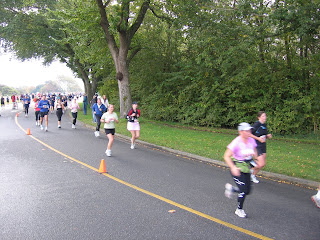
Victoria has a beautiful course, though. It started in downtown and led us through a park, then down to the water. As we were coming back the sun was rising so there was a (and this one’s for you, Beau) pretty sunrise to look at for a few km. And the sun even came out for a few minutes near the end. Though a few minutes after I crossed the finish line it did start to rain again. Which made me a pretty happy I hadn’t decided to go for the full. Oh, and about 15 km into the race there was, and I’m not joking here, a beer station. Really. It was just someone outside their house handing out half-full cups of beer. And it was actual beer. I didn’t have any, but I saw them opening the cans. How cool is that? I’m sure they would’ve had a lot more takers if they were at to the finish line, though. It’s hard to run and drink at the same time, and when it’s beer you don’t want to spill.

I ran this race with a cold. Glen managed to give it to me about three days before the race and I spent those 3 days cursing him. Ask him, he’ll tell you. Though that morning I did feel much better, it probably wasn’t the best idea for me to be out in the chilly morning air trying to run fast for 2 hours while I was also trying to get over a cold. I went downhill in the health department for a few days after that. I’m just now starting to feel normal again (a week and a half later). So why didn’t I just not go? Well, number one is I’m far too stubborn to let a little illness stop me. Or stupid. I’ll leave that one up to you. Second, I worked my ass off for three months for those 2 hours. Third, I had already booked the hotel room, registered and paid for the race, and finagled several trades so I could get the weekend off work. So short of a nuclear holocaust, I was going to run. And I managed what is known as a “personal best”, so there!

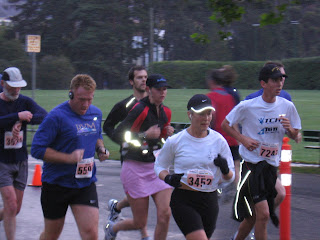
After the race Glen felt the need to point out all the salt that had precipitated on my face. And it was a lot. I hope it comes through in the picture. I theorize it may have been because of the cold I was sweating a little more than usual, and with no rain to wash it off, it just stayed there. In a gross, crusty ring around my cheeks and ears. Yummy.


So that’s my experience running the half marathon in Victoria. Stay tuned for my next adventure!

Thursday, August 30, 2007

The Epic Hike that is The South Boundary

For those that I forgot to tell or just don’t really talk to much, I recently came back from a two week backpacking trip through the Jasper wilderness, on a trail known as the South Boundary. It starts at Medicine Lake on the road up to Maligne Lake and goes south, and skirts the south boundary of the park as it heads towards the Icefields Parkway. The last day it actually leaves Jasper National Park and comes out at Panther Falls in Banff, about 10 minutes south of the Columbia Icefields. I went with my sister (Jana) and our friend Charlene (or Slacker, as she is better known). Sounds like a good way to spend a holiday, right?

So the South Boundary Trail is a long walk through the bush. Really. That’s pretty much it. But since elaboration is obviously necessary, I’ll lay out the “highlights” of each day, as best I remember them-with a little help from the trip log book I kept. The whole trip was 14 days long, and we covered 172 km of trail.

Day 1: Jacques Lake Camp (the camp we stayed at that night), 13 km (the approx. number of km we hiked that day). A hike on relatively flat ground to get to delightful camp with picnic tables, designated tent pads, and one of the famous “green thrones” Jasper is so famous for (for those who don’t hike the Jasper backcountry-a molded plastic toilet with no walls but an actual seat). I would later learn that that last amenity was few and far between on this trip, and quite a luxury. Not much happened on Day 1, really. Jacques lake is quite beautiful, though. I would go back there for an overnight or a day trip if I happened to be in Jasper for a while and needed something to do. Oh, and we had one of the more filling meals of the trip this day, 2 boxes of Kraft Dinner between the 3 of us.


Day 2: Grizzly Camp, 11 km (I’ll mention at this point that none of the distance markers on the trail were right-they didn’t even agree with each other. One would say it was 12 km to the next camp, but then you’d get there and the sign would say you’d just gone 14 km. And though my sister tried to estimate the distance, she was off by a few km most days, though we don’t blame her, since getting any information on this trail was extremely difficult.). It rained through the night, so as we walked through the bush for the first part of the morning, none of us wearing our rain pants, we got completely soaked from the brush overhanging the trail. Then we ended up in a burnt area that a forest fire had ripped through a couple years previous. There were signs before we got there warning of unstable trees that could fall at any time. One of the tips Slacker liked was to “spread out to prevent multiple casualties”. I actually didn’t mind this day so much. There was a little up, a little down, and the lack of trees meant you could see the surrounding mountains and scenery. Though the trees did creak rather ominously when the wind picked up and pieces of bark kept flying off them and hitting us. We also had to climb over a few fallen burnt trees, effectively covering our pants and hands in a lovely layer of black soot. One nice thing about this day was that fireweed had grown up in most of the area. So there were pretty flowers to look at, and as an added bonus, they don’t hurt when they whack you in the face like tree branches do. The campsite was another story. A fire pit plunked down next to the river, with a small cleared area to pitch your tent. The “privy”, as they were now being referred to, was a log nailed between two trees with a hole dug underneath it. Classy.


Just a note here, after the first 2 days my memory gets a bit fuzzy, so I’ll be relying on the log book to try and remember it. It’s not that I have a bad memory or anything, but with a total of 14 days hiking through bush that all looks the same and staying at campsites that are all basically the same, it all really starts to blur together.

Day 3: Climax Camp (or pleasure camp, as Jana calls it), 12 km. It rained the night before, so everything was wet again. The only really eventful thing that happened today was when we came to a river we thought we had to cross without a bridge. There was some significant profanity from Jana when we got there and didn’t see any bridge, or even any remains of a bridge. And it was a raging river, people. We’re talking one of those sub-zero, super fast flowing mountain rivers. Since I was the biggest, I had a go at crossing it with my sandals on. Yeah. I got about ½ a metre from the bank and it was suddenly at crotchular level. And when the water’s that cold, crotchular level is not good. Plus it was going way too fast and there’s no way I would’ve made it, since the damn thing was probably 6 or 8 metres across, I had only made it ½ a metre. So after some serious studying of the map I decided we had to go farther up the river, since it looked like the bridge went perpendicular to this one ridge, and where we were trying to cross we were parallel. So the boots went back on and we walked up the river-and hallelujah, there was a bridge! Thanks to the Flying Trail Crew of 1992 (there was a sign), we had a bridge to cross over. A rickety bridge with gaps between the boards big enough for Slacker to fit through, but a bridge nonetheless. That was pretty much our excitement for the day. After today we didn’t see people for 8 more days.


Day 4: Rocky Forks Camp, 10 km. This is the day I started to lose my ambition for hiking through the bush and the total boredom that comes with it. On this trail the actual trail itself is a deep rut-2 feet deep in places-through the bush. So you spend most of the day staring at your feet trying not to trip over tree roots and rocks. Super fun. This is also the day the conversation died a little, so there wasn’t much talking on the trail for the rest of the trip. One of the main reasons for this, though, is that the trail itself is really narrow, so you have to hike single file. And when there’s 3 of you all spread out, it’ hard to hear each other, no less carry on a conversation. So we didn’t do much talking after this. Rocky Forks camp wasn’t exactly stellar. The only water source was a really scungy looking, stagnant pond. It was as though they just picked a spot and plunked the camp down right there.


Day 5: Lagrace Camp, 18 km. Today was the longest day, but we had a break planned when we got to Medicine Tent Camp about halfway through the day’s hike. When we did get to Medicine Tent we felt pretty cheated. It was one of the nicer camps, it had benches, a rather comfy privy log, and it was next to one spot in the river where it went deep into a pool off to the side and the current wasn’t too strong, so you could’ve had a bath there if you wanted. But we only stopped for a bit to dry a few things out in the few minutes of sun we had and have a quick granola bar. Then it was on to Lagrace Camp, which wasn’t too bad. It started to rain just as we were starting dinner, so after we cleaned everything we got into the tent for shelter. I should say now that we had a crib board and cards to pass the time, and Slacker and I played quite a few games of crib and lying-down war. Lying-down war is when you’re both lying in the tent and too lazy to actually sit up, so instead up putting your cards down you hold them up above you so you can lie down and play. I don’t know what the final tally for wins and losses was between us for the trip, but I think it ended up fairly even in the end.


Day 6: Cairn Pass Camp, 12 km. Today I really started to smell the stench that is 3 unwashed people. The last night was easily the worst, but even today when I crawled into the tent I could smell us. It’s now wonder we didn’t see any animals, they probably smelled us a mile away. What’s that you smell Bob? I think it’s unshowered human. Maybe we should avoid that particular area today… Anyways, today we went over Cairn Pass, which is 2250 metres in elevation. It wasn’t actually too bad a climb, in my opinion anyways. The view was good from the pass, though it would’ve been even better if the cloud cover had been higher. It rained the night before, so everything was completely soaked, including us when we got to camp. There was a big fire pit at Cairn Pass Camp, though, and we decided that the rainy, miserable nature of the weather warranted starting a fire if we could actually get one going with wet wood. Well Slacker managed to get one started and we kept it going for a bit with some already chopped wood someone had left there previously. We dried out most of our socks, burnt a few of them, and this is where I burnt Glen’s camp towel. It still works, there’s just a brown spot on it that won’t wash out now. It was quite a sight to see our socks draped over the edge of the fire pit with steam coming off them. This was also the day I discovered that the hiking itself isn’t nearly so boring when you get a good daydream going. After today I didn’t have too many days where I was totally bored. Tired of trudging through the bush, yes, but not bored. Today was also the day Jana started whipping out songs from “Annie”. It’s actually quite fun belting out “Tomorrow” at the top of your lungs in the middle of nowhere.


Day 7: Cairn River Camp, 14 km. Half-way done. Finally! It had rained through the night, but we decided we didn’t want to wear our rain pants today. Big mistake. The trail was overgrown with bushes, so we all ended up totally soaked. And not just wet, but totally soaked, the kind of wet where your pants start sticking to your legs. Then we came to a river we had to cross. Not a very big one, easily crossable. Jana took her boots off to cross, but Slacker said hers, which actually had “waterproof” stamped right on them, were so wet there was no point taking them off. So she walked right through. I took one boot off and tested the rocks, but they were pretty slippery, and at that point all I wanted was to get to camp and crawl into my sleeping bag. Plus my boots were pretty wet already, so I put my boot back on and tromped through the creek with my boots on. It wasn’t so bad, actually. I poured the puddles out of my boots on the other side and we continued. We then crossed another creek and found camp. I decided that today was finally the day to wash my hair, since it had now been 7 days since I had done that. Plus my scalp was getting wicked itchy. So in the arctic fresh river I washed my hair. I swear it’s never felt so good to have clean hair.


Day 8: Southesk Camp, 9 km. Paradise. That’s how I would’ve described this camp the day we strolled into it. But I’ll get back to that later. It rained on us during the night and stopped just as we were straggling out of the tent in the morning. We hiked for a bit in the bush and then ended up in another burnt area, which we followed for quite a while. We then crossed a river, merely guessing that the trail continued on the other side. This was based on some ancient signs Jana spotted on the other side. Then we followed a sign that said “foot bridge”, hoping it would take us to a bridge so we could get across the bigger river. This trail wound up a hill, through the burnt area, and actually led us outside the national park boundary and into an area that had obviously been used by many, many quads. So there were a lot of trails to follow and not a lot of signs to tell us which to take. Thankfully I can read a map half-decent and we actually managed to make it to the foot bridge and across the river. Where our next challenge started. The bridge took us across the river, but the trail just sort of ended. And we were still in one of the burned parts, so it was even hard to guess. Then someone saw an axe mark cut into a tree just ahead. So far we’d seen them on trees just next to the trail-we figured they were for the parks people so they could find the trail after winter. So, like breadcrumbs, we followed the axe marks and finally caught up with the trail. At that point it turned into a clear-cut line that had been made as a firestop, which seemed to stretch forever. But then we made it to camp. Camp was a little piece of land that jutted out into a little shallow lake, and it had a pretty nice view. It just happened to be warm and sunny that day, so Slacker and I decided we were going for a swim. 8 days without a shower and you’d be thinking the same thing. It wasn’t too bad, actually. And the night we spent at Southesk was one of the 2 that it didn’t rain on us. As an added bonus, we also got to start the next day out with dry socks and boots, courtesy of the sun.


Day 9: Issac Creek Camp, 13 km. Just before we got to Issac Creek is where Jana had actually drawn in a part on the map, because it wasn’t actually there. Up until this point there’d been an actual dotted line that came on the map itself, but now we were basically guessing where the trail actually went, on the map anyways. I blanked out a good chunk of this day, since it was mostly through the bush, and boring as hell. Just before we got to camp we had to cross another creek, this one was a bit bigger than the ones that came before it. I was wandering around looking for a spot when Jana got tired of waiting and just gum-booted it right through. But it worked and we got to camp. Issac Creek was also a horse camp, thus there was a delightful green throne that I enjoyed a little too much, and benches to sit on. Well, the sitting wasn’t so great since they’d left the logs round, so they were a little hard on the arse, but it beats sitting on the ground.


Day 10: Arete Camp, 17 km. It rained on us during the night. There were actually 2 trails leading from Issac Creek Camp. One was pretty wide and well-used, the other was narrower but still well-used. The narrower one of the national park hiker/horse sings pointing to it. So two roads diverged in a wood… We discussed which to take, but I was pretty sure the parks people wouldn’t put that sign up for no reason, and I managed to convince Jana and Slacker of the same thing. So we took the road less traveled. This was still the part of the trail the map didn’t have on it, though this was the day we came back onto the established part of the map. The hike itself was mostly flat that day, but I was a little on edge since I wasn’t sure we had taken the right trail, and if we ended up having to backtrack, it was basically my fault. So I felt much better when we finally came across the Arete ranger cabin and I knew we were going in the right direction. And when I knew Jana and Slacker weren’t going to lose it on me. It sprinkled for a good portion of this day, and most of the time we were actually in camp, so we spent the better part of the day inside the tent. It was starting to get pretty cold today, and I think this is the first day the toques came out. This was also the day we decided would be good for the chicken noodle soup we brought. And for future reference, one packet of Lipton’s chicken noodle soup is not enough food for 3 hikers.


Day 11: Brazeau River Camp, 13 km. I had rained again during the night, so once again Jana was packing a wet tent. The hike to Brazeau River wasn’t so bad, though I though at one point Slacker was going to lose it when one sign said we still had 3 km left when we should’ve been almost there. Just before we got to camp we went by the Brazeau ranger cabin, and does that guy have it made! Stockpile of chopped wood, outhouse with walls, warm cabin, and to top it off, a nice little fence around his yard. It almost makes you want to become a park warden. Anyways, the sun broke through the clouds for a few hours once we got to camp, so Slacker and I managed to do a little washing in the river while it wasn’t too cold. Brazeau River Camp was pretty deluxe-2 picnic tables, actual tent pads and a green throne with a nice view to boot. We even managed to play a few games of cards on the picnic table before the weather turned and started to rain on us again.


Day 12: South Wolverine Camp, 9 km. This, in my opinion, was one of the two best days of the trip. It started out really terrible. It rained all night and as we were leaving in the morning it was so cold I think it may actually have been snowing. When we did get to our stop for the night we could see a fresh coat of snow on the mountains. And given that the cloud cover was pretty low but we could still see the snow from the valley, you can guess it was pretty cold. As we were nearing camp, Slacker pointed ahead and said she saw people. After 8 days, the sight of other people was actually quite strange. It was almost like, what are you doing out here? I thought we were the only ones out here in the bush. So we kept going, and it kept raining. We were so miserable when we got to camp that we set up the tent and crawled into our sleeping bags to warm up. After a nap we got up and made dinner, and as we were finishing, four guys strolled into camp, dripping wet. That was when the clouds started to break up and blue sky began appearing. It widened out over the whole valley, and soon we were literally basking in the sunlight. Literally. Jana has a video of the basking. Then, the guys managed to get a fire started, and invited us to enjoy-so we grabbed our wet socks and boots and dried everything as best we could. And at that point, dry socks were a luxury we thought we’d never get. And then, the piece de resistance, the icing on the cake, one of the guys offered us chocolate. That’s right, chocolate. After 12 days in the bush, chocolate. The look on Slacker’s face was priceless. We went to bed very happy that night.


Day 13: Boulder Creek Camp, 10 km. We woke up to frost and below zero temperatures. It was bloody cold, and really hard to get moving. Charlene’s boots, though drier than they’d been the previous day thanks to the fire, were basically frozen solid. The sky, however, was clear and blue, which gave us hope that the day might not totally suck like the many that had come before it. After some cold cereal (which paled in comparison to the feast the men brought), we went on our way. That day I decided not to wear my rain pants. I should have. I was soaked in seconds, and since the soaking agent just happened to be ice crystals, I was freezing. Not since I moved from Alberta have my thighs been so cold. The guys had warned us the day before that the trail disappeared and basically turned into a stream, and they didn’t lie. At one point, it was no longer trail, but us hopping between high points in a marsh, trying to figure out where to go next. We did find the trail again. The mountains, I might add, looked particularly nice that day because of their pristine new coat of white snow. The hike wasn’t too bad after we got out of the marsh, though it did start to go uphill in a big way. Boulder creek campground was a little windy, but not too bad. We had the one dessert we brought that night-a freeze-dried concoction called cherry blast. It was really more like goopy pie filling. I thought it wasn’t too bad, but Jana and Slacker didn’t really like it. Today, I might also mention, was gorge day. By that I mean that all the food we’d been rationing the whole trip because we didn’t want to run out we could eat. So we basically gorged and ate everything there was to eat except what we knew we weren’t going to need the next day on the hike out. It was awesome.


Day 14: Home. 10 km. This was one of the days it didn’t rain on us the night before, and trust me when I say Jana was ecstatic she didn’t have to carry a wet tent up over Nigel pass. We had breakfast at lightning speed and away we went. I might also mention this was probably the only day I was actually ready to go before Jana. The trail up the pass was just that, up. Up in a big way. There was no pussy-footing about it, you had to get over the pass, so you hike straight up the really steep hill. But it was worth it. Even though there were clouds there was a nice view and I may have gotten a little picture happy at this point. After the pass it was pretty much downhill through meadows and bush to the end. There was a few km’s of trail where we could hear the highway and almost see cars, but we were going parallel to the road. It was very frustrating that we could hear the cars but we weren’t there yet. Slacker almost had a breakdown from hunger, but once she got her fruit-to-go out and had that she was better. And did we get some looks from the tourists when we waltzed out of the bush. I think they may have been able to smell us. Let’s just say the bridge over Panther Falls cleared off pretty quick once we got there. Then we managed to convince Dad to go back through Jasper, and we had Jasper Pizza and beer, and everything was good again. Ahh, sweet civilization…


And now for everyone’s favorite, the little tidbits I feel the need to elaborate on:

Breakfast. Jana and Slacker had come up with this fantastic idea of putting cereal in a Ziploc bag with a tablespoon of powdered milk for breakfast. That way, it was just add water and voila, breakfast. It was actually pretty good most days. I found the Lucky Charms a little too sweet, but Slacker happily traded me for her share of the granola cereal. This carried the added bonus of being a really quick breakfast with no need to set up the stove or even do any dishes. Just rinse off your spork and the Ziploc bag and away you go. It was brilliant, really.

Food. I was hungry almost the entire time we were out. My stomach was making noises I haven’t ever really heard before. Strange grumblings, and pretty much all the time, not just when I was actually hungry. I think it may have been all the Lipton’s Sidekicks we were eating. Which, with the exception of some rice and mashed potatoes, was pretty much all we ever ate for dinner. Near the end I was actually missing meat. Me. But the up side of that would be that I actually lost 9 lbs on that trip. Granted, at least 3 of those were water weight from dehydration, but that’s still 6 lbs of actual weight. So there’s your answer for quick weight loss-go hiking in the middle of nowhere. But it’s not like we didn’t bring much food. When we left, we had 3 10 litre drybags and one 20 litre and they were so full we were almost having trouble closing them. This also made the first few days of pulling the food up to the bear pole on that skinny rope Jana brought a little unnerving. It also took 2 people pulling on the rope to hoist everything up until about 4 days from the end, when Jana managed it by herself.

Jana the camping nazi. So I realized after a few days that while hiking, my sister gets a little annoying. And here’s why. When Jana wakes up for the day she jumps out of her sleeping bag, packs all her stuff and has everything out of the tent before I even have time to roll over. After a while she started to whine that I took too long in the mornings. But what’s the rush? We got to most camps before 3 in the afternoon, so it’s not like we were pressed for time. And I’m on vacation. I’m allowed to move slow. I need time to lie there and just be thankful I didn’t get eaten or otherwise violated by a bear in the middle of the night. Is that so wrong?

TP. At one point in the trip I realized if I kept going the way I was with my toilet paper, I was going to run out. We had each brought 2 full rolls with us, and we figured that would be plenty. It wasn’t. Near the end, I was down to using maybe 3 or 4 squares in the hopes that the last little bit left on my roll would make it to the last day. It didn’t. But luckily Slacker doesn’t use nearly as much TP with each visit to the privy as a Damgaard, and she had a sizeable amount on her roll the second last day when I actually ran out. So she was more than generous when she said I could borrow for the next day if I had to go. Never before have I needed to “ration” my toilet paper. It wasn’t a pleasant experience. And I don’t want to experience it again. Though it did make me very grateful for a while afterwards that every time I went to use the facilities I could use as much as I wanted.

So there it is, my 2 weeks in the bush, summarized as best I can.